
Are Microbiome Tests a Scam? We’ve Got Receipts 💅🏽
If you have IBS and you keep seeing ads for at-home stool tests like Viome or Tiny Health — I need to talk to you. Because I know exactly what's going through your head. You want answers. You want to actually see what's going on inside your gut so you can fix it. And these companies make it look so good — the color-coded graphs, the detailed reports, the do's and don'ts list. I get it. But something came out in February 2026 that I cannot stop thinking about, and you deserve to know.
The Study
Researchers took the exact same stool sample and sent it to seven different microbiome testing companies. And the discrepancies were wild. What one company considered normal, another flagged as abnormal. Same sample, completely opposite conclusions. But the biggest one — and this is the one that really got me — was C. diff. C. difficile is a bacterial pathogen. It causes loose stools, watery diarrhea, stomach pain, and in more serious cases, fever and bloody stools. Half the reports came back positive. The other half showed nothing. That's not a small margin of error. That's a coin flip on something serious.
And here's why that matters: if your results say positive and you don't actually have it, you might start an eradication protocol or take antibiotics you don't need — and wipe out your good gut bacteria for no reason. Things can go wrong really fast.
So… are all at-home tests bad?
No, and I want to be fair here. The tests I use with clients — GI Map, Gut Zoomer, Genova Diagnostics — are legitimate. But here's the key difference: you can't just order them online. They have to come through a practitioner. Your functional doctor, your naturopath, your nutritional therapy practitioner will order those for you. And that matters, because the test is only as good as the person reading it.
I see this all the time. Clients come to me with a GI Map that a previous practitioner said looked fine — and they still feel terrible. When I look at it, there's something that seems normal on paper but isn't optimal in the context of their symptoms. There are inflammation markers that technically fall within range but are significant for this specific person. Making those connections is the practitioner's job, not the algorithm's.
I had a client with severe acid reflux who had done the Gut Zoomer before coming to me. Her markers looked clean. The practitioner she worked with didn't know what to do, so she was put on HCl support she didn't need — which made her acid reflux worse. When she came to me, she could barely eat anything. We worked together using a symptom-based approach, and she healed her acid reflux within 10 weeks. No new tests needed.
My Recommendation
A qualitative symptom assessment — basically a detailed look at what your body is doing across different systems — can tell you more than a stool test, cost less, and be a much better starting point. In my practice I use something called a symptom burden graph. You fill out a questionnaire covering everything from digestion to energy to skin to blood sugar, and it creates a map of where your body needs support. We work from there. And honestly? Most of the time, that's all we need to start seeing real results.
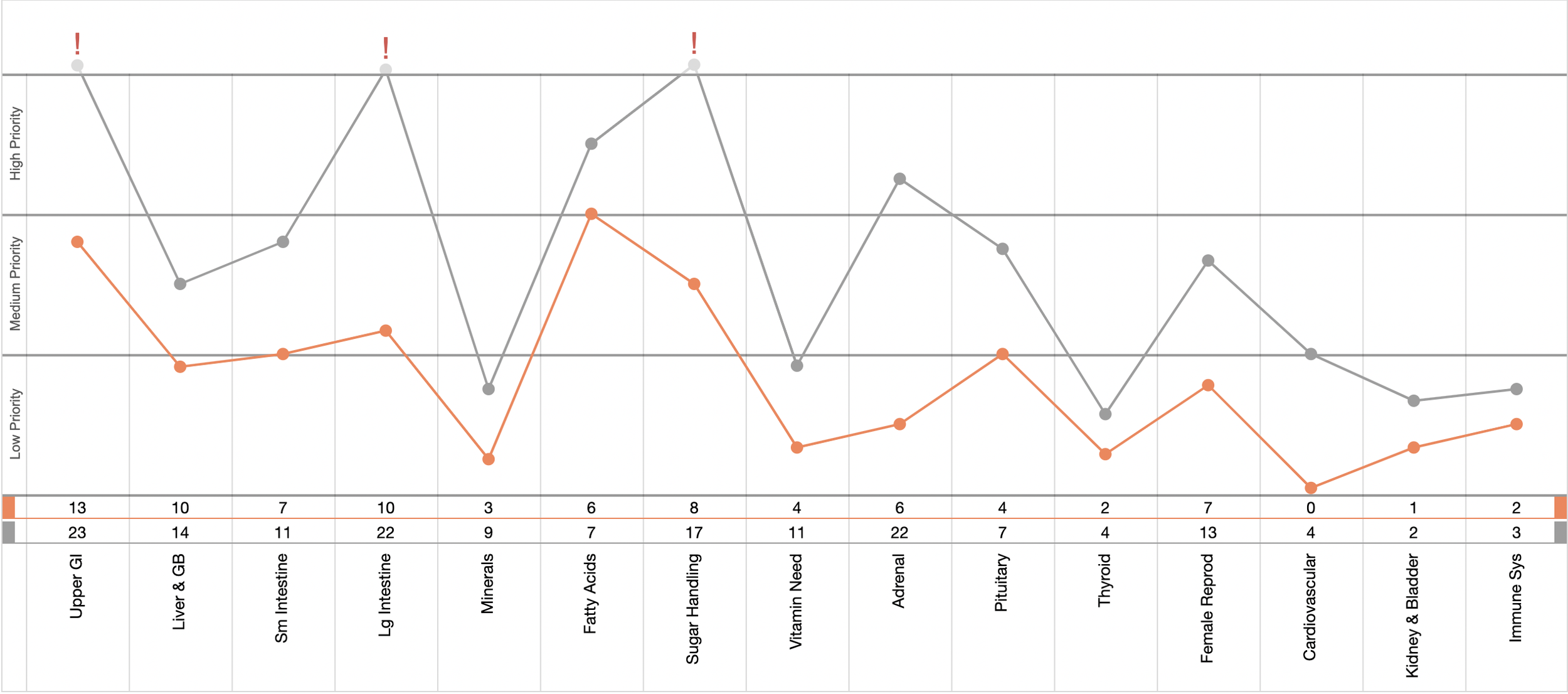
BEFORE: CHRONIC ACID REFLUX AND CONSTIPATION. AFTER: REDUCED ACID REFLUX AND RESOLVED CONSTIPATION
All of this to say: if you've already done one of these tests, don't panic — just don't take the results as gospel. If you're thinking about doing one, save your money unless a trusted practitioner is ordering it and you know they can interpret it well. And if you're looking for a starting point right now, looking at your symptoms is probably the most honest and useful thing you can do.